
My local creek is the site of a foreign invasion. You wouldn’t know to look at it; it seems like an ordinary urban creek, full of jagged rocks, algae, and litter; maybe some ducks skimming along the top. But according to the bright yellow sign by the bridge, there may be thousands of invaders lurking just below those unsuspecting webbed feet. You can’t miss the sign. I sure didn’t. Alert! It said. “This must be something really bad,” I thought. Maybe there’s nuclear radiation nearby; the sign is yellow and black, after all. Maybe there’s a serial killer on the loose, though the sign seemed too permanent for that sort of announcement. I looked closer. The sign said “These waters contain New Zealand Mudsnails.”
Okay, then.
Snails, really? I grew up catching all sorts of fun aquatic creatures in the creeks near my home. My favorites were the caddisflies, those long, sickly-looking bugs that build their protective dwellings from anything they had on hand — tiny rocks, sticks, silt, etc. I don’t remember many snails gracing the cold creeks of my youth, but I’m sure I would have loved finding them, too. I know I’d have patiently waited for them to emerge from their twisty homes, only to poke them back into submission. I can’t decide if small humans make the best, or the worst naturalists. This was my state of mind when I first saw the notice. Now, let me tell you how I went from laughing at the thought of invader snails to having a dedicated set of “creek research boots,” a dish brush in my backpack, and a special irritation with fishermen from Idaho.
The rest of the sign was as follows: “STOP the spread of invasive New Zealand Mudsnails (NZMS). Avoid contact with the stream to prevent their spread. Decontaminate any boots and gear after contact with the stream.” A photo of a dime accompanied this section of the sign. FDR’s silvery profile was visible, as were the words “we trust.” In whom we were supposed to trust was a little less clear, as the rest of the coin was covered in dozens of tiny black and brown dots, presumably the snails. Though it was hard to tell what they were, really. The black dots looked more like granules of sand.


“NZMS have a negative impact on fish and native invertebrates,” the sign continued. At first glance, it’s not easy to see how such tiny creatures could significantly impact the ecosystem of a puddle, much less a stream the size of Thornton Creek. I’m sure most people are familiar with the concept of invasive species, most places having at least a few well-known ones. Maybe there’s a particular plant that has taken over their valley, or a rodent that chews all the vegetable gardens with nothing to keep them in check. One thing all invasive species (including humans!) have in common: bringing destruction to the natives.
But how did some tiny Kiwi snails get halfway across the world into my creek in northeast Seattle? And boy are they tiny; here they average 4-6mm in length. I decided to do some digging around.
In New Zealand, the mudsnail, known by its latin name Potamopyrgus antipodarum, is an innocuous little aquatic creature, favoring mostly freshwater and lots and lots of algae, which it happily munches under cover of darkness. Colonies there can also become quite large, containing up to 100,000 snails per square meter, but they are kept in check by a dozen or so species of parasitic flatworms called trematodes, which cause reproductive sterilization in their hosts.
That is not the case elsewhere in the world. Outside of their native range, the mini mollusks are virtually indestructible by normal standards. At least for short periods of time, they can withstand extreme temperatures and moderate amounts of salt water and pollution. In fact, they thrive in “moderately polluted” and brackish shorelines, so Lake Washington is perfect for them! They can even survive the digestive systems of a variety of fish and birds, their main predators planet-wide.
Without flatworms hampering the snails’ reproduction, the populations of European and North American colonies often reach astronomical levels. To date, the highest number of NZMs recorded was in Lake Zurich, Switzerland. There, the exotic mollusks numbered 800,000 per square meter – they had colonized the entire 34 square mile lake in seven years flat.
The snails’ other secret to population growth? They don’t need any males. In New Zealand, the mudsnails have three sexes: males and females with the usual two chromosomes each, and a third: females with three chromosomes (known by the fancy name of triploids). These girls eschew traditional mating in favor of cloning themselves by the thousands. Are they sisters? Are they mothers? Are they their own grandmas? I don’t know, but don’t think about it too much or you’ll break your brain, too.
This attack of the clones makes it possible for each colony’s lineage to be traced separately. All populations outside of New Zealand and Australia are made up of the triploidy females. There are three distinct colonies of NZMs in Europe: one in the British Isles called Potamopyrgus jenkinsi (same snail, different scientific name) which is now the commonest freshwater snail nationwide; another colony that settled in the estuaries of Denmark, and the last that has spread over most of the rest of the EU. Each group arrived separately, and we know this because of the genetic differences between them.

It’s the same story with North America: the very first Potamopyrgus antipodarum discovered on the continent were found in the Middle Snake River near Hagerman, Idaho, in 1987. A couple years later, more of the mudsnails were discovered in the Great Lakes, but they weren’t the same snail clones. The two colonies were genetically distinct from one another. Fun fact: the NZMs found in the Great Lakes were actually genetically identical to the snails inhabiting most of Europe. From this little truthbomb, scientists were able to deduce that the Great Lakes snails were likely descended from stowaways, unintentionally delivered in contaminated ballast water from European ships. As for the colony taking over the western U.S. and British Columbia, the original snails are thought to have been accidentally introduced with imported rainbow trout meant to provide sport for fishermen.
NZMs took a surprisingly long time to reach the United States, given their stature, propensity to propagate, and environmental hardiness. They showed up as their alter-alter ego, Paludestrina jenkinsi, in Lough Neagh, about twenty miles east of Belfast, Northern Ireland, in 1837. The Irish specimen was collected along with a bevy of other aquatic snails by G.C. Hyndman, and left, in a single box, to the Belfast National Historical and Philosophical Society upon his death in 1867. It was a hundred and fifty years after those drab little shells were first boxed up in Belfast that a malacologist, running a routine stream survey of The Nature Conservancy’s Thousand Springs Preserve in southern Idaho, came upon the unfamiliar species in the inlets and channels he knew so well along the Snake River.
By the time he set out on his bi-annual check-up on endangered aquatic fauna, Dwight W. Taylor, an expert on mollusks, had already discovered almost a hundred new types of gastropods throughout his career. As such, his initial, unpublished TNC report revealed an almost prophetic intuition about what he had discovered. He posited that the exotic species came from “a considerable distance, [the] best guess at this time being New Zealand.” He accurately predicted that the all-female population would reproduce at an alarming rate, and that this would cause strife among the native aquatic snail species, as they would be forced to compete with the prolific NZMs for everything from food to shelter against predators.
Taylor observed that the exotic mudsnail was quick to retreat to the underside of river rocks when exposed. In doing so, they amass into thick black mats of hundreds of thousands, impervious to the efforts of native snails to follow suit, literally leaving the locals high and dry. Definitely not a good place to be if you’re a snail. The NZMs’ reaction that Taylor witnessed in the streams along the Snake River is intuitive. They are alerted to the presence of predatory fish by chemical stimuli in the water. I’d say they have sixth sense, but since they’re missing a couple of the originals, I guess it all works out the same in the end.
This sense is so finely tuned that, in the original study on such behavior, researchers observed that the snails even assessed the fish’s diets in deciding whether or not to flee. When exposed to water that had contained fish whose food sources included mollusks, the snails generally made their way underneath the rocks to safety, even though their own food source was located at the top of the rocks. When, alternatively, they were put into water that had held only bait-fed fish, they preferred to stay topside and keep chowing down on algae.
Taylor narrowed down the time period for the arrival of these super snails to the area based on the date of his last survey, claiming that if the invasive species had been present along the Middle Snake River two years earlier, in 1985, he would have discovered it at that time. As it was, he recommended a follow-up visit within the year to monitor the spread of the new species, appended with a minor request for either a fish scope or glass-bottomed bucket to assist with underwater observation.
I could have used one of those, myself, when I went sloshing through the mouth of my neighborhood creek, searching for NZMs one early spring day. I imagine that if this creek had been on D.W. Taylor’s survey, it’d be reported as “present, but sparse.” It took a while to search, because everything was so muddy. I’d spy a likely looking rock, make my way over to it, then wait for a couple of minutes for the eddies of underwater dust to settle in order to reacquaint myself with the rock’s exact location. Then I’d fish it out.


“Nothin’,” I said to myself. But I spoke too soon.
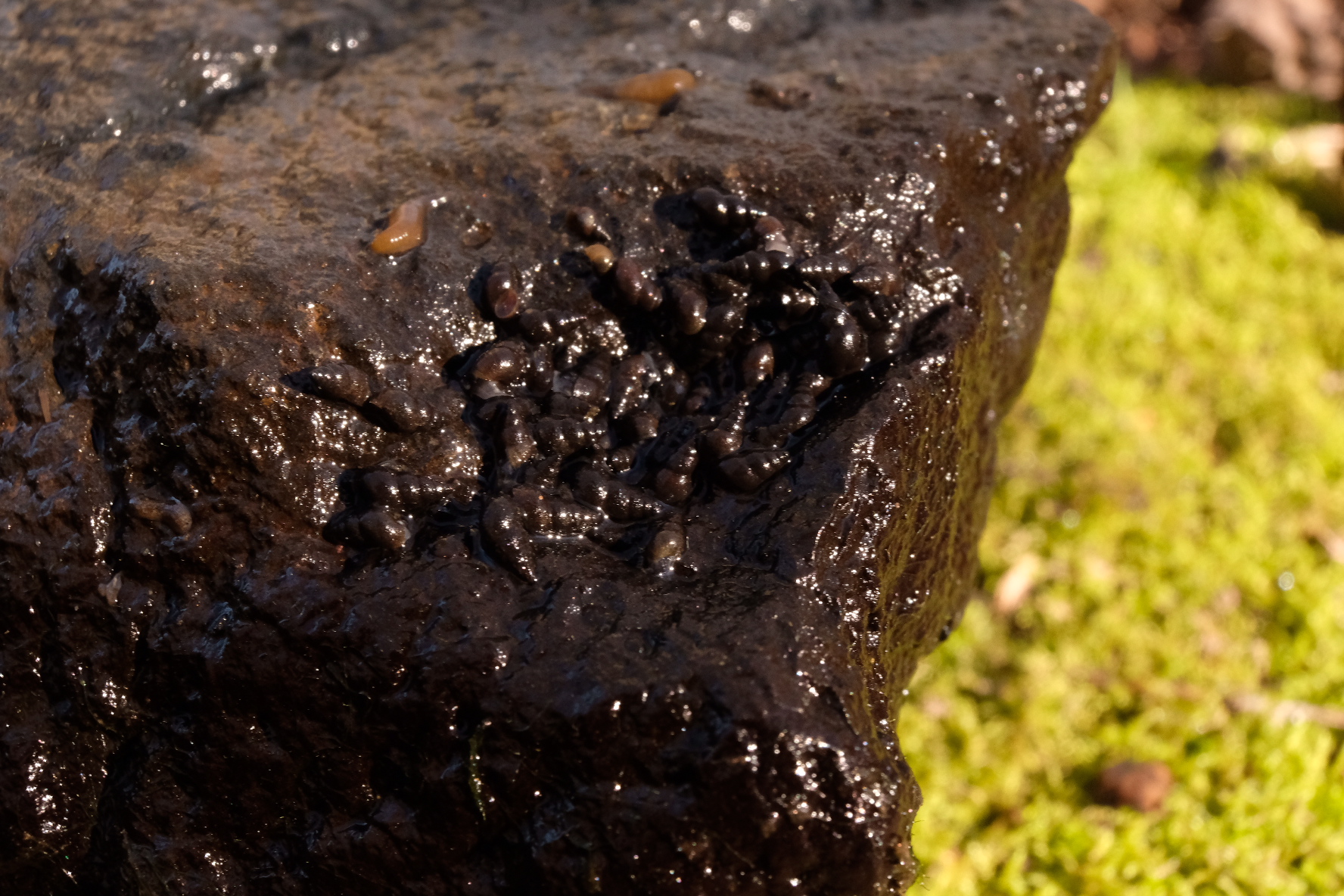
There were one or two of them clinging to the fist-sized rocks along the banks, but I waded a bit deeper. I hauled out a rock about four by six inches. There, in a chipped-off corner of the underside, I finally found what I was looking for. Glittering black in the wintery, late afternoon sun were about eighty New Zealand Mudsnails. I know this because I scraped them out of their crevice onto my palm and counted them.
They occupied a small space no bigger than my thumb, all squished together; Lilliputian corkscrews in my palm. They crackled gently when I rolled them around in my fingers. I set them there expectantly, as though they would unsheath themselves and attempt an escape. Then I remembered: I could stand there for a good long while without that happening. If my hand stayed damp, they’d outlast me by several weeks. Unsurprisingly, these invasive little buggers are extra hardy. They can survive on dry land for 24 hours, and on damp land, for up to fifty days! This is how they are able to travel so well.
Imagine it’s summertime. You take your kayak and head to the lake for a day of paddling. You drag your craft through the crumbly shore, and get it out on the water. Your oar slowly carves a path through the leafy fronds of elodea and pondweed rising up from the lake bed a few feet below. Maybe you botch the disembarkation of your vessel and take an unplanned dip in the shallow waves at the beach upon your return. You now have Potamopyrgus antipodarum in the crevices of your paddle, hidden under the lip of your kayak, lodged in the tread of your water shoes, clinging to the seams of your life jacket, and anyplace else that might stay damp for a while where they could squirrel themselves away until you go kayaking out of town the next weekend.
Every single one of those NZMs could survive the wait. And it’s worth it to them – all it takes is one. For sexless, parthenogenetic creatures, a party of one is as good as an orgy. Even the massive population in Lake Zurich could have been started with just a single New Zealand Mudsnail. Each female is capable of producing about 230 offspring per year after reaching maturity.
Looking at the batch of twisty little dames I’d plunked onto my outstretched hand at my local stream, I had the urge to do some math – something that only happens to me once every decade or so. I had eighty snails in my hand. Assuming they were sexually mature (at least 3-6 months old), that meant that by the end of the summer, they could collectively have 18,400 young.
Yes, you read that correctly. Yes, I double-checked the math. Yes, you may join me in having a minor stroke.
As they dried they lost their luster and faded to a dull, chocolate brown. When it was time to set them down, I became seized by indecision. “Where should I even put them?” I thought. It felt wrong to put them back, as I would have done with a native species. But it’s hard to break a habit, especially one that’s been ingrained since childhood: “make sure to put the salamander back under the same log you found it.”
As futile as it seemed, I didn’t want those snails to go back and just have 18,000 babies in my creek. I looked around. Everywhere else seemed wrong, too. If I put them on the nice, dry pathway, someone might come along and collect some on the bottom of their shoes and transport them somewhere new before they dried out. If I tossed them into the woods, a bird might inadvertently ingest them and deposit them into virgin waters elsewhere. There were no good options. I compromised and put them far from the creek in the driest patch of grass I could find, hoping they’d wither in the sun sooner than later.
Eighty down, half a million to go. Maybe I’ll go back next week. For now, I have to go scrub my boots.
 Anna A. Snook
I’d love to hear from you! Drop a line here: